Nursing, and midwifery beforehand have been one of Canada’s oldest professions, and the timeline of this career parallels the constant labor struggle of Canadian workers. From serving in both world wars, to pay imbalances between genders, Nurses have had to undergo a great deal of struggle to contribute their part of the labor movement. Currently, Canadian nurses are supported by their own personal labor union but are fighting lack of pay as well as, burnout and increasing turnover in the profession. As written in a study by Nowrouzi et al. “The aging and decreasing workforce not only inadequately meets the needs of the public but places stress on working nurses and government and organizational budgets.” The current issues nurses are facing along with their historic significance shows the importance of looking into the practice and how its progressed through years of struggle.
Mccallum, Mary Jane “Indigenous Women, Work, and History, 1940-1980.” University of Manitoba Press. 2014.
Nowrouzi, Behdin et al. “The Quality of Work Life of Registered Nurses in Canada and the United States: A Comprehensive Literature Review” International Journal Occupational Environmental Health (2016): 22(4), 341–358 https://www.ncbi.nlm.nih.gov/pmc/articles/PMC5137552/
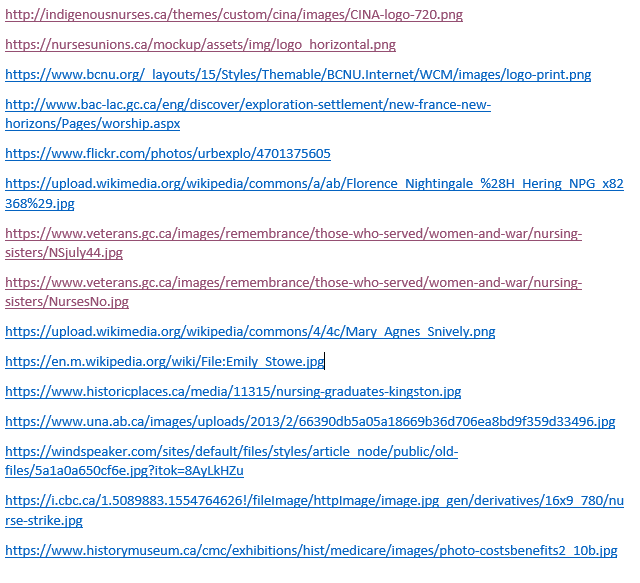
Jean Goodwill, one of the first indigenous people to become a registered nurse in Canada in 1954. She was also a founding member of the Canadian Indigenous Nurses Association.
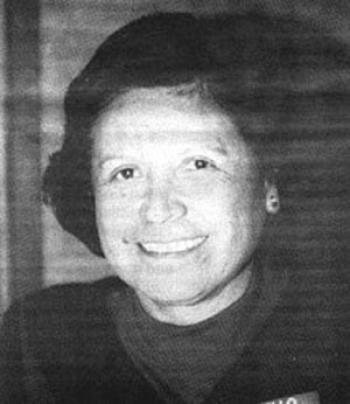
The 70’s were a progressive time for nurses in numerous ways. Unions began to take form, and the question of gender issues began to be addressed. In 1975 a group of indigenous nurses formed the Registered Nurses of Canadian Indian Ancestry (Now the Canadian Indigenous Nurses Association) as a way to give voice and representation to Indigenous people working in the field, as well as focus specifically on the health needs of the aboriginal community. Mary Jane Mccallum comments on the need for this because “to Native people, social programs such as health and education are embedded in distinct historical relations and reciprocal treaty responsibilities between Indigenous people and the federal government.” The following decades had a wealth of changes to long standing traditions. In 1981 the Canadian Federation of Nurses Unions was formed. While there’d been individual nurses’ unions beforehand, this one represented the profession at a national level and still stands today. Throughout the decades nurses organizations and unions helped represent those in the profession fight for better rights and further their goals. One such example is the United Nurses of Alberta striking in 1988. They took this action as a means to fight against various cutbacks to wages and benefits.
The United Nurses of Alberta going on strike in 1988.
Labour issues are always prevalent and continue to this day, one of the main issues currently being tackled in the workplace is the issue of pay gaps between genders. As of 2019, every branch of the CFNU is also affiliated with their province’s respective federation of labour, providing more support for the workers should they need it. Canada’s nurses have a long and storied history fascinatingly intertwined with the struggle of labor. From Indigenous nurses seeking representation, to women like Emily Stowe battling for the need for education, to the work being done by the unions today, Canada’s nurses have been toiling away at improving both their working and living conditions.
Members of the Quebec Nurses Association protesting burnout and mandatory overtime in 2019.
Graph of nurses income at the beginning of the depression.
Like many other professions, nursing was hit hard during the Great Depression. Unemployment ran high and numerous other issues followed. One of the most impactful pieces from the Depression is the Survey of Nursing Education in Canada. The report caused a series of changes such as the closing of hospital schools and greatly raising the requirements to join the profession. One noteworthy part of the survey is its call for the socialization of the practice. The writer, Dr. Weir states “Economic obstacles that separate the patient from the nurse should be removed… socialization of nursing services, with adequate distribution of the financial burden through a form of state health… is an important factor in any successful attack on Canada’s major health problem.” Unemployment continued at a steady rate until the second world war began and many nurses were called overseas to contribute to the war.
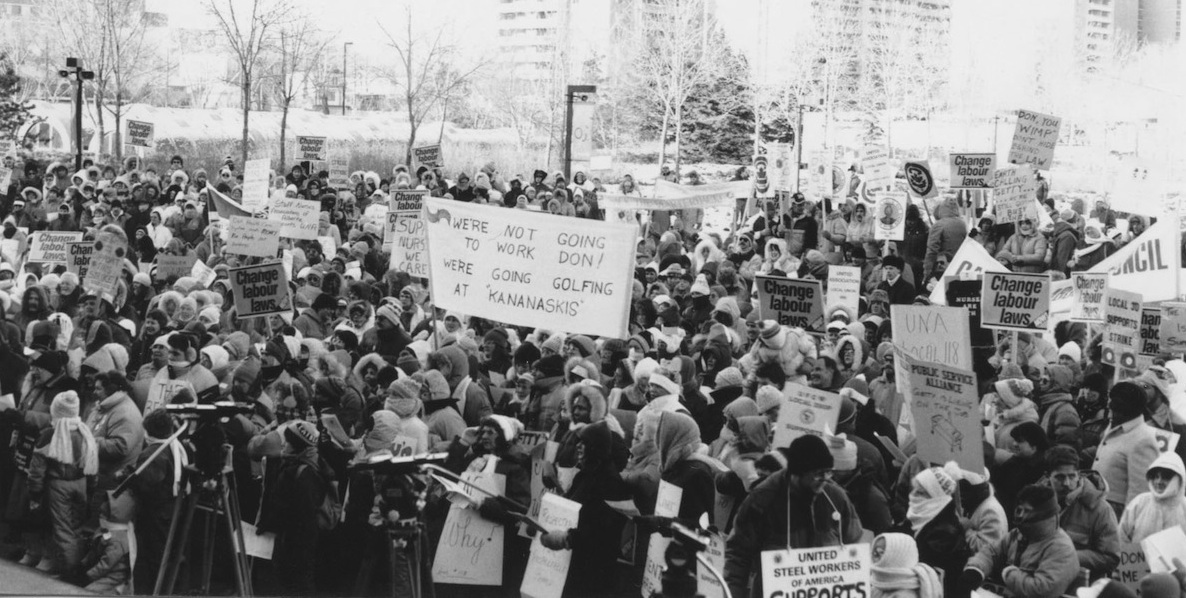
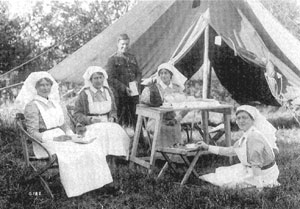
Nurses sisters in France in 1944.
At the onset of the war many old restrictions still applied such as being unmarried and without children, as well as graduating with the proper education. Nurses that served in the military during the war were commissioned officers, granting them a certain amount of power in the military. Due to the high influx of nurses going overseas, as well as the broadening of careers for women in general at this time, there was a shortage of nurses in some provinces which would continue until well after the war. Due to the high demand for the profession, it granted women and nurses more power to collectively bargain for worker’s rights such as fighting for the eight-hour day. After the war many nurses left the workforce while the profession itself made changes to adjust to peacetime conditions. The following decades had lots of change for health organizations, such as reconstructions and renovations of hospitals. Possibly the most important changes for the profession and for Canadians as a whole was the passage of the Medical Care Act and the Royal Commission on Health Services in the 60’s which provided universal health care for the country.
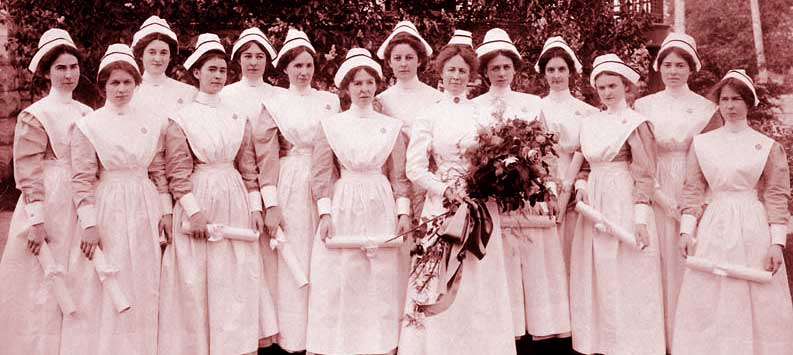
In 1883 the Woman’s Medical College was erected in Toronto by suffragist Emily Stowe. The College was created as a reaction to women being declined the opportunity to be educated on and practice medicine throughout Canada. Nursing schools began popping up throughout the country. During this time people working in this practice were primarily young white women. This was mainly due to the selection criteria of the nursing schools, with Cynthia Baker et. Al saying “training programs to define nursing within their institutions as a respectable occupation, differing from domestic service, for young, single, white women… ruling out many immigrants, and until the 1940’s, no African Canadian or First Nations women”
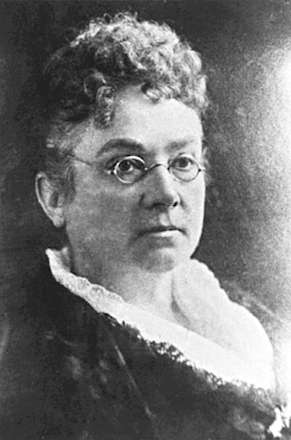
PROFILE – EMILY STOWE
Emily Stowe was one of the most important women in the history of the profession.
Stowe is a hugely important figure in the history of nursing. She’s considered to be the first woman to practice as a physician in Canada. She was one of the first women to attend classes at the Toronto School of Medicine in 1871. Throughout her life she faced difficulty frequently fighting for women’s rights, being involved in a criminal trial in 1879 for assisting another woman in getting an abortion. Her battle for women’s rights led her to being vice-president of the Canadian Women’s Suffrage Association and helping create the Woman’s Medical College.
By the early 1900’s official Nursing organizations had spread to every province in the Country. Mary Agnes Snively was the president of the Society of Superintendents of Training Schools for Nurses in both the U.S and Canada. She was instrumental in the formation of the Canadian Nurses’ association which helped regulate things such as, scheduling, registration processes and various other labour issues for nurses across Canada. The majority of nurses moved to working in private health fields however, with the first world war there was a shift in labour into moving more into working in public health. The first world war is where nursing became a big part of the Canadian public eye, as evidenced by the Library of Archives Canada noting “2,000 women enlisted with the Canadian Expeditionary Force and went overseas… the presence of nursing sisters near the front and close to the line of fire… highlighted the importance of female caregivers.”
Nursing has been one of Canada’s oldest professions and has had a significant impact on the workforce. In early confederation and the years beforehand, nurses were often synonymous with churches and worked as laywomen, midwives, or other forms of health work. Indigenous women were also vital in health care pre-confederation. Their history is often ignored in the narrative of nursing history, noted by Lux, M.K which states “After Confederation, the federal government aggressively pursued a policy of assimilating Indigenous Peoples and eradicating their cultures, which included efforts to suppress their healing knowledge and practices. ”
The title for religious hospitals to be built in Canada.
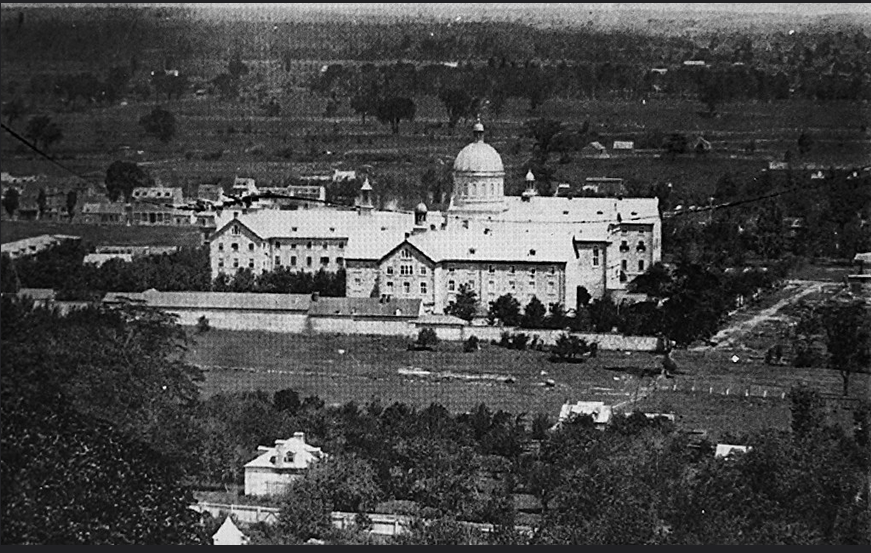
Image of the Hotel-Dieu in Montreal ~ 1869
In 1639 the first Canadian Hospital was established in Quebec City. A few other hospitals were founded throughout the rest of French Canada in the following years. This series of “Hotel Dieu’s” were religious institutions followed the Christian model of charity and began the first set of training people as nurses. This work was mostly done by the work of a congregation known as the Grey Nuns founded by Marie-Marguerite d’Youville. The profession of nursing, and health care in general began with religious institutions. The Grey Nuns essentially acted as the first nurses in Canada, assisting those in need during smallpox breakouts and provided various social services during Canada’s early years.
During the early 1800’s lay hospitals began popping up throughout the country, the primary differences between these hospitals and earlier versions was the separation of religion. Lay hospitals were primarily run by Physicians and bourgeoning nurses. The Canadian Association of Schools of Nurses notes that “Initially, epidemics played an important role in the establishment of lay hospitals. As migrants flooded into Canadian ports, many arrived with contagious diseases such as typhoid and cholera.” The quality of care was rather low, however, due to the lack of formal training. Due to this demand for a higher quality of care, the first hospital training school was opened in 1874. Lay Hospitals and the nursing schools in Canada were heavily inspired by Florence Nightingale’s model of nursing and greatly improved the health care field. As said by the CASN due to the rampant outbreaks of disease and lack of formal training by religious personnel, “1500 to 1860 A.D. has been called the “dark period of nursing.”
Florence Nightingale who brought about the modern period of nursing. The current model of nursing is still extremely similar to the model she created and practiced.







 Nursing In Canada